
It’s often only when we pause to reflect on a journey that it becomes possible to see how far we’ve travelled.
In 2026, we will mark 10 years since CEI opened our doors. Today, we’re a global team working from five offices, with projects spanning 20+ countries across Asia, Europe, the Americas and Australasia.
We’re kicking off a year of reflections by considering some of the ways CEI is making a difference right now – through our globally leading work, our role as a go-to learning and implementation partner, and our focus on delivering meaningful change for people in need.
Read on for insights from CEI’s ongoing and recently completed work.
Helping families stay together
Supporting families to function well changes children’s lives. CEI’s Common Elements work is doing just that.

Common Elements are building blocks of what works: the discrete techniques, practices or sets of strategies that recur across multiple evidence-based programs. These evidence-informed techniques can be low-cost and universal, embedded in everyday frontline work and scaled across service systems, supporting a continuum of evidence-backed support. It is an approach we’re advancing globally, in sectors ranging from early childhood, to community services, to mental health.
Common Elements are core to CEI’s six-year partnership to develop and implement the Family Preservation and Reunification Response ('the Response'), a statewide family services reform in Victoria, Australia. A vital thread in this work is partnership with the Victorian Aboriginal Child and Community Agency in identifying and scaling cultural common elements – a key innovation that brings together academic evidence with Aboriginal ways of knowing and doing.
The Response has resulted in 18% fewer children entering care. One of 34 agencies delivering the program, Uniting (Victoria/Tasmania) reported in January that 97% of their Response families said the program made a positive difference to their lives, and nine in ten reported increased parenting confidence and improved parenting skills and access to supports. Uniting’s Implementation and Evaluation Lead, Mia Lorenzo, noted that “when families feel heard, respected and worked alongside, meaningful change becomes possible”.
Ensuring lived experience informs services
“… [C]o-creation is more than participation,” says Edwin Mutura from the Global Mental Health Peer Network. “It is evidence that our voices can lead to solutions that meet actual needs and drive lasting impact.”

CEI is collaborating with Edwin and other Lived Experience Experts to develop best-practice guidance on embedding Lived Experience in mental health research, for Wellcome Trust (a project commenced in 2025). How, why and under what conditions can Lived Experience collaboration make the greatest impact for more relevant and impactful research?
Separately, for Youth Futures Foundation, CEI has developed evidence-based guidance on promoting the voices of young people in research, particularly those marginalised through systemic inequalities. We are currently developing a second set of guidance, specifically focused on impact evaluation.
Embedding equity and lived experience is central to good implementation. Our focus on co-creation, co-leadership and shared governance is not just in line with our values, it can be vital to lasting change.
Making sense of evidence and putting it to use
Our mission is to bridge the ‘know-do’ gap. One critical way we do this is helping make sense of research and getting it into forms people can use – from practice guidance to toolkits.
A CEI-led evidence review in 2025 underpinned development of the UK’s first national practice guidance on how best to support parents living with adversity. The review’s most significant recommendation is that evidence-based parenting programs should be a central part of regular service provision, as they play a key role in improving child and parent outcomes in families experiencing multiple and complex needs.

In Singapore, our national positive use guidance for families on how best to manage screentime for children and young people (aged 7-18), developed last year, is grounded in research and the advice of mental health professionals.
Globally, we’re leading a current project for UNICEF to bring together evidence on how best to strengthen and sustain kinship care – the cornerstone of many child protection systems, particularly in low- and middle-income countries. And we’ve partnered with Wales Centre for Public Policy to investigate how policy work can be better geared toward implementation.
Better evidence use in philanthropy is an ongoing strand of our work. Our latest contribution, created in partnership with Tanoto Foundation last year, outlines ten practical lessons on how organisations apply evidence to advance their missions –highlighting emerging sector trends and benchmarks.
Scaling what works
More and more, we are tackling the tricky business of taking promising interventions from pockets of excellence to sustained, scaled impact. (See our article on the challenges of scaling HERE.)
In 2025, we developed the first ever framework and assessment tool detailing what is needed to successfully scale education programs, for Education Endowment Foundation. And we are the long-term evaluation partner in Movember’s Scaling What Works program, supporting 17 promising initiatives to scale their mental health initiatives for men and boys in Australia, the UK and Canada – the subject of a protocol publication in January.
Distilling and sharing the growing understanding of what is needed to effectively implement, scale and sustain is essential to pushing the field forward.
Empowering leaders and teams
As a learning and implementation partner, CEI supports leaders and teams to embed quality evidence and implementation into their everyday work.
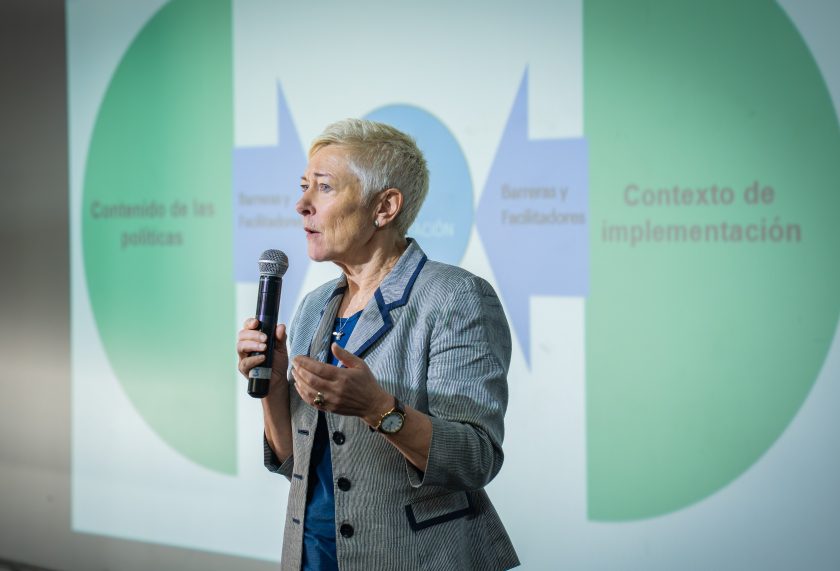
Last year, we collaborated with Youth Futures Foundation’s Evidence into Action program, coaching UK community-based organisations on how best to apply evidence in improving employment prospects for marginalised young people. We’ve partnered with National University of Singapore in developing and teaching the Asia-leading Master of Science in Behavioural and Implementation Sciences in Health since 2024, and we continue to build capacity worldwide through regular workshops for government and non-government partners (including, in January, in Chile).
Core to our commitment to support and grow the field globally is co-hosting the Evidence and Implementation Summit, a sector-leading biennial event, with our partners. The 2025 event, held in collaboration with the Implementation Science Health Conference Australia, drew 700 practitioners, leaders, researchers, policymakers and innovators from 25 nations.
“Grateful for the chance to be part of the conversation and to keep asking how we make change not just evidence-based, but operational, scalable, and real,” noted one attendee.
A year of reflections to come
The past year proved as busy and productive as ever. And we're just getting started on our decennial!
We’re thankful for the partnerships, the shared learning and the opportunity to continue making a difference globally.
We look forward to partnering with you in the coming year, and to sharing more insights on impact as we reflect on a decade of CEI.